
It is a fair question. The Support at Home system is designed to be flexible, but that flexibility comes with rules, categories and budgets that are not always easy to understand at first glance. Add in different funding levels, co-payments and separate programs that sit alongside Support at Home, and it is no surprise many people feel unsure about what is allowed.
This guide explains what you can spend a Support at Home package on, how the service categories work and where people often go wrong when managing their budgets.
How Support at Home funding works
Support at Home is the Australian Government’s in-home aged care program. It replaced the previous Home Care Package system and provides an annual funding amount that is delivered and managed quarterly to support older people to live safely and independently at home.
Funding is allocated across eight levels. Lower levels are designed for people who need a small amount of help, while higher levels are for people with more complex or ongoing needs. As you move up the levels, the total funding available increases, allowing for more frequent services or more specialised support.
Your package can only be spent on approved aged care services that meet your assessed needs. It cannot be used like cash and it is not designed to accumulate indefinitely. Careful planning matters, because unspent funds above the allowed limit are not carried forward.
Another important feature of Support at Home is that services are grouped into categories. Each category is treated differently for funding and co-payments, which is where much of the confusion starts.
The three Support at Home service categories
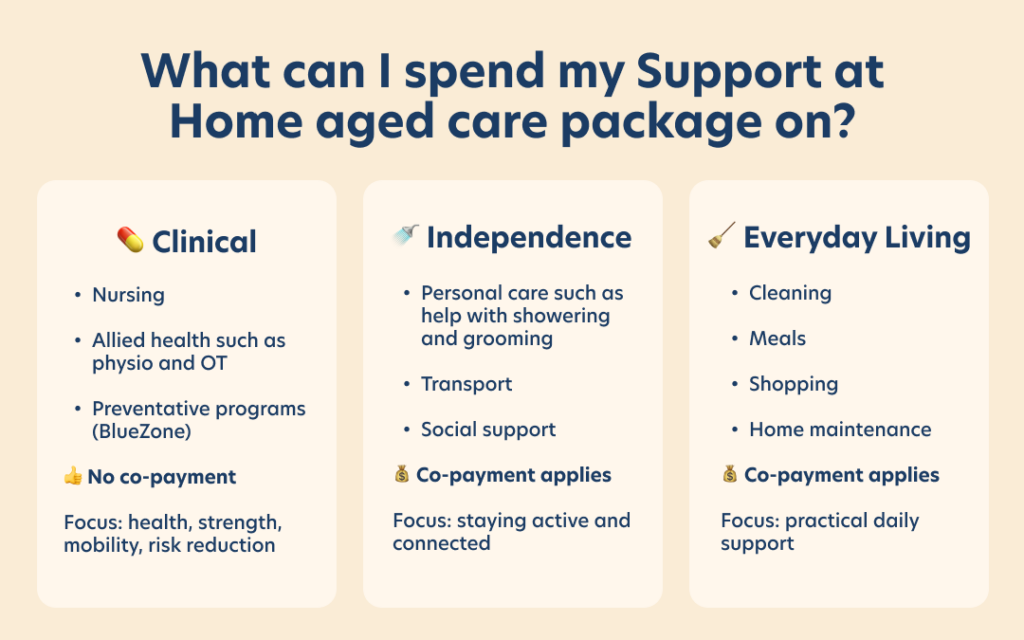
All ongoing Support at Home services fall into one of three categories: Clinical, Independence, or Everyday Living. Understanding the difference between them is essential to understanding what you can spend your package on.
Clinical services
Clinical services are medical and health-related supports that require qualified health professionals. These services are aimed at managing health conditions, reducing risk and preventing deterioration.
Common clinical services funded under Support at Home include nursing care such as wound management, medication support, continence care and monitoring of chronic conditions. Clinical services also include allied health.
Allied health covers services such as physiotherapy, occupational therapy and exercise physiology. These supports are often used to improve strength, balance and mobility, recover after illness or injury, and reduce the risk of falls. For many people, allied health is one of the most effective ways to remain independent at home for longer.
Preventative allied health programs, such as BlueZone, also sit within this clinical category. These focus on maintaining physical capacity and function rather than waiting for problems to arise.
Clinical services do not attract a means-tested co-payment under Support at Home. For people who are eligible, this means clinical and allied health supports can be accessed without additional out-of-pocket contributions beyond the package budget itself.
Despite this, clinical services are commonly underused. Many people focus their spending on day-to-day help and delay clinical care until a crisis occurs. In practice, regular clinical and allied health support can help avoid hospital stays and slow functional decline.
Independence services
Independence services are designed to help people remain capable, confident and safe in their own homes. These services support function and autonomy rather than medical treatment.
Independence services may include supports that help people stay mobile, connected and engaged in their community, such as transport to essential appointments or social support that reduces isolation. They also include personal care such as help with showering and grooming.
Independence services generally attract a means-tested co-payment. The amount depends on an individual’s financial circumstances and is assessed by the government.
These services play an important role, but they are most effective when balanced with appropriate clinical care. When budgets are spent heavily in this category without review, people can find themselves needing higher levels of care sooner than expected.
Everyday Living services
Everyday Living services cover assistance with the practical tasks of daily life. These are the services most people think of first when they hear “home care”.
Examples include domestic assistance such as cleaning, laundry, meal preparation, shopping assistance and light home maintenance. These supports can make a significant difference to quality of life, particularly for people living alone or with limited mobility.
Everyday Living services attract a means-tested co-payment. Because they are often delivered regularly, they can consume a large portion of a package budget if not carefully managed.
These services are valuable, but they can also be where overspending most often occurs. Without regular budget reviews, everyday help can crowd out services that support long-term independence.
Standalone programs you may need to apply for separately
Not everything older people need at home is funded through their ongoing Support at Home package. Some supports sit in separate programs and require their own assessment or application.
Assistive Technology and Home Modifications
Assistive Technology and Home Modifications, often referred to as AT-HM, is a standalone program. It covers items and modifications that improve safety and accessibility at home, such as mobility aids, bathroom modifications or changes to entrances and pathways.
AT-HM funding does not come out of your regular Support at Home budget. You need to be assessed and approved separately, even if you already have a package.
Short-Term Restorative Care
Short-Term Restorative Care is designed for people who need intensive, time-limited support, often after a hospital stay or health setback. The aim is to restore function and independence rather than provide long-term assistance.
This program operates separately from Support at Home and has its own eligibility criteria and time limits. It can run alongside a Support at Home package but must be applied for specifically.
Palliative care
Palliative care supports people with life-limiting illness and focuses on comfort, dignity and quality of life. While some aspects of care may overlap with Support at Home services, specialist palliative care is accessed through a separate health pathway and funding arrangement.
Palliative care is not funded from your regular Support at Home package, but will still be delivered by your home care provider.
What you cannot spend your Support at Home package on
Support at Home funding cannot be used for general living expenses, rent, utilities, or groceries unrelated to care. It also cannot be used for services that are not directly linked to assessed aged care needs or that are delivered by unapproved providers.
The intent of the program is to fund care and support, not to supplement everyday household costs.
Common spending mistakes to avoid
One of the most common mistakes people make is overspending early in a quarter. Support at Home budgets are managed on a quarterly basis, which means funds are released progressively across the year.
People are only allowed to carry over a limited amount of unspent funding. Under current rules, you can bank up to 10 per cent of your quarterly budget, or $1,000, whichever is lower. Any unused funds above this limit are not carried forward and will be lost.
This makes it especially important to monitor spending closely. If services are underused for too long, funds can quietly expire. If they are overused early, support may need to be reduced later in the quarter.
Another common issue is failing to actively review how funds are being spent. Small increases in service frequency can gradually erode available funding without being obvious at first.
Many people also rely too heavily on Everyday Living services and delay clinical or allied health care. This can feel practical in the short term but often leads to greater care needs over time.
Spending your package wisely over time
A well-managed Support at Home package balances immediate support with long-term wellbeing. Everyday help keeps life manageable, but clinical and allied health services often deliver the greatest benefit by helping people stay mobile, safe and out of hospital.
Because funding operates on a quarterly cycle, planning needs to be ongoing rather than set-and-forget. Reviewing services regularly and adjusting them as needs change helps ensure funds are used deliberately rather than lost or exhausted too early.
With the right mix of services and informed planning, a Support at Home package can do far more than provide help. It can support independence, stability and confidence at home for years to come.