
The good news is that a range of support can be organised to help you recover safely at home, and much of it is government-funded. This guide explains what’s available, how to arrange it and what to do if care is needed urgently.
What home care is available after a hospital stay?
The type of support you can receive at home after hospital falls into a few categories, depending on your needs.
Nursing care covers things like wound dressings, medication management, monitoring your recovery and managing any clinical needs from your discharge plan. A registered nurse can visit you at home, meaning you don’t need to travel for follow-up care.
Personal care includes help with showering, dressing, moving around safely and managing toileting. That’s particularly important in the first days after surgery or a significant illness when you may not have full strength or mobility.
Allied health support such as physiotherapy, occupational therapy or exercise physiology can help you regain strength, relearn daily tasks and reduce the risk of falls or readmission.
Transport to bring you home from hospital on discharge day, and to get you back for follow-up appointments without relying on family.
Domestic help such as cleaning, meal preparation, laundry and shopping all help you to rest and focus on recovery without worrying about keeping the house running.
Most people need a combination of these services in the weeks after hospital, and the mix can change as recovery progresses.
How to arrange home care before you leave hospital
The best time to arrange post-hospital care is before you’re discharged, not after. Most hospitals have a discharge planning team, including social workers and discharge planners, whose job is to help coordinate support for patients going home.
If you or a family member is concerned about coping at home, raise it early with your nurse or doctor. Ask to speak with the discharge planner.
A home care provider can also be contacted directly. If you have Support at Home funding and call Envigor while you’re still in hospital, we can have a care plan ready for discharge day, including transport home if needed.
If care is arranged at short notice, providers can often start within 24 to 48 hours.
How is post-hospital home care funded?
There are several ways home care after hospital can be funded.
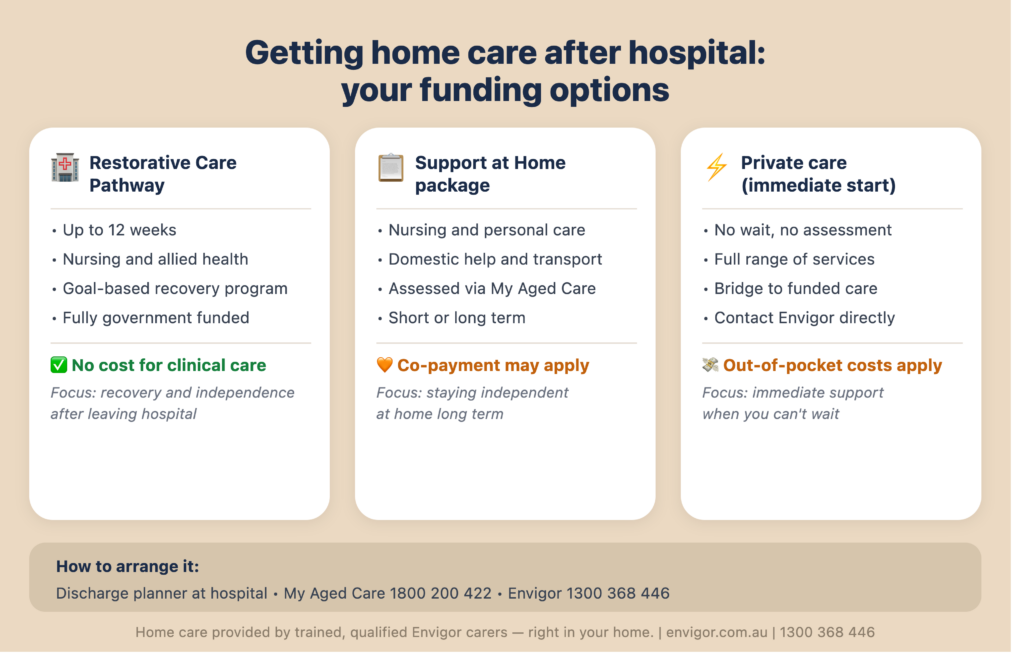
The Restorative Care Pathway is a government-funded program specifically designed for people who need short-term support to recover and regain independence after a hospital stay, illness or fall. It provides up to 12 weeks of goal-focused support, including nursing and allied health, at no cost for clinical services. Read more about the Restorative Care Pathway here.
Support at Home funding can also cover post-hospital care as part of a person’s ongoing care package, including nursing, personal care and domestic assistance.
Private care is available immediately for anyone who doesn’t yet have government funding in place, or who needs care to start before an assessment can be completed. You can transition to government-funded care once approved. Talk to us about organising private care.
DVA Gold Card holders are entitled to home nursing and personal care through the Department of Veterans’ Affairs, which can cover post-hospital recovery needs.
What to prepare at home before discharge
A little preparation before coming home can make recovery significantly smoother. If possible, arrange these before discharge day.
- Have food in the fridge and easy meals organised for the first few days.
- Medications to be picked up from the pharmacy.
- Make sure pathways around the home are clear and fall risks are reduced: loose rugs, cluttered hallways and poor lighting are common hazards.
- Ensure a phone is within easy reach, particularly overnight.
- If mobility is limited, move essentials to where you can reach them without climbing stairs or stretching.
A care provider can also do a home safety check before or on the day of discharge to identify anything that might need attention.
Signs that more support is needed
It’s not always clear in advance how much help will be needed. Watch for signs in the first week that care should be increased: missed medications, difficulty getting in and out of bed or the shower, a wound that isn’t healing well, significant fatigue, poor nutrition, or low mood and anxiety about managing alone.
If readmission is a concern, it’s far better to increase care at home early than to wait until a crisis point.
Frequently asked questions
Can I get a nurse to come to my home after surgery?
Yes. Registered nurses can visit you at home to manage wound care, dressings, medications and recovery monitoring. This can be arranged through a home care provider and is covered under government funding programs including Support at Home and the Restorative Care Pathway.
How quickly can home care start after hospital discharge?
If arranged in advance through the hospital’s discharge planning team or directly with a provider, care can start on the day you come home. For urgent situations, most providers can arrange care within 24 to 48 hours of a request.
Is home care after hospital free?
Clinical services including nursing and allied health are fully government funded under the Restorative Care Pathway and the Support at Home program. Get in touch with My Aged Care to register for an assessment if you aren’t participating in those programs. There is a waitlist so don’t delay. Some services such as cleaning and home maintenance involve an income-tested co-contribution for some people. Private care is available immediately but is paid out of pocket.
Can my family member arrange care on my behalf while I’m in hospital?
Yes. A family member, carer or the hospital’s discharge team can contact a home care provider to begin arranging care. Most providers are set up to work with hospital teams and can coordinate a care plan remotely before discharge.
What’s the difference between post-hospital care and ongoing home care?
Post-hospital care is typically short-term and focused on recovery. It may last anywhere from a few days to a few months. Ongoing home care continues longer-term to support independence at home. Many people begin with short-term post-hospital care and transition to ongoing services if needed.