
But with the new Support at Home program rolling out, many people are asking: Will I pay more? Will I pay less? How do the budgets actually work? Also why is one spelled programme and the other program? (That one we can’t help you with!)
This guide focuses on the dollars and cents to help you understand the financial differences between the two programs.
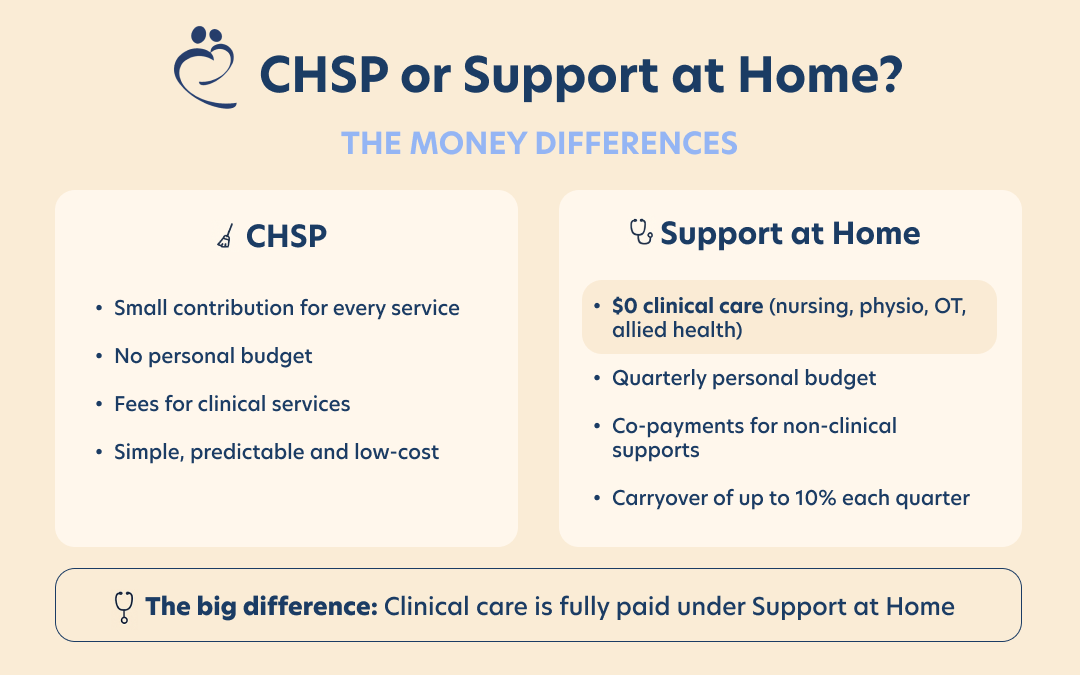
How CHSP works: simple contributions, no personal budget
CHSP is designed to be as straightforward as possible. Under CHSP:
- You don’t receive a personal budget.
- The government pays most of the cost straight to your CHSP provider.
- You make a small contribution for each service you receive.
- There is no formal income and assets test.
- Providers must have hardship policies so nobody misses out based on cost.
For many older Australians, this is one of the biggest benefits of CHSP because it feels affordable, predictable and easy to manage.
But because CHSP is an entry-level program, the level of support it can offer is limited. When your needs grow, or when you start using more services each week, the financial picture starts to shift.
How Support at Home works: your own quarterly budget
Under the Support at Home program, you are assessed into one of eight funding levels, each with a quarterly budget attached. This becomes the pool of money used to pay for your services.
It works like this:
- You’re given a personal budget based on your assessed needs.
- Your provider charges for the services you use.
- The government pays the bulk of those costs.
- You may have to pay a co-payment, depending on your income and the service category.
- You can carry over up to 10 per cent (or $1,000) of your unused budget each quarter.
It’s a more structured system, and with structure comes more variation in what people pay. But here’s the part many people don’t realise…
Clinical care under Support at Home has no co-payments
This is one of the biggest financial advantages of the Support at Home program.
The federal government pays the full amount if you have clinical supports such as:
- Nursing
- Physiotherapy
- Occupational therapy
- Podiatry
- Allied health focused on mobility, falls, continence or chronic conditions
You do not pay a co-payment, no matter your income.
For many Australians, this can outweigh any cost differences compared with CHSP.
Imagine you need weekly wound care, physio to help with strength and balance, or regular nursing checks. Under CHSP, these services can attract contributions each time and in some regions may not be available consistently.
Under Support at Home, you pay nothing for clinical care and you may receive more frequent or ongoing support as part of your assessed needs level.
For people with chronic health issues, this can make the entire program more cost-effective than CHSP, even if some non-clinical services (like cleaning or gardening) attract higher co-payments.
What you will pay under Support at Home
As mentioned above, clinical supports are fully funded. But you will face co-payments for Independence and Everyday Living services
These include:
- Personal care
- Respite
- Cleaning
- Gardening
- Shopping assistance
- Home maintenance
- Transport
Some people will pay less than they do under CHSP. Some will pay about the same. Some will pay more, especially if they are higher-income or using mainly non-clinical supports.
The hidden cost difference people miss
Under CHSP, you only pay small contributions but that includes clinical services.
Under Support at Home clinical care is 100 per cent funded. This can replace hundreds (or sometimes thousands) of dollars a year in out-of-pocket health expenses.
So even if you pay slightly more for cleaning under Support at Home, you may save significantly by no longer paying anything for physio, nursing, or allied health required to stay safe at home.
When Support at Home may be cheaper overall
Support at Home may save you money if:
- You have regular clinical needs
- You’ve had falls or mobility issues
- You’re recovering from surgery or a hospital stay
- You need nursing oversight for medications or wound care
- You want help improving your strength, balance or independence
These are precisely the areas where Support at Home removes all co-payments.
When CHSP may still be more affordable
CHSP may remain the cheaper option if:
- You mainly use cleaning, gardening or transport
- You don’t need clinical support – though this is rare because the very nature of needing home care would suggest you need some clinical care, especially if you want to stay at home for the long term
- Your needs are light and stable
- You prefer small, simple contributions rather than structured budgets
In these cases, CHSP’s low-fee model may be the most cost-effective program.
It’s all about your situation
Understanding the financial differences between CHSP and the Support at Home program isn’t straightforward because what you pay depends on your needs.
But here’s a simple rule:
If you need a lot of clinical support, Support at Home may cost you less overall because clinical care has zero co-payments.
If you only need a cleaner and a bit of basic help, CHSP will usually be cheaper.
The best approach is to look not just at what you’re paying today, but at what support you’re likely to need over the next year or two. If your health is changing, the financial benefits of Support at Home may be greater than they first appear.
The information in this article is general in nature and does not take into account your personal financial situation, needs or objectives. It should not be relied upon as financial advice. Before making any decisions about aged-care funding, fees or services, you should consider your individual circumstances and seek independent advice from a qualified financial adviser or Services Australia.