For some people, the process is relatively smooth. For others, particularly those with complex health needs, those navigating the system for the first time, or those trying to arrange care urgently, it can feel slow, bureaucratic and hard to get straight answers. That’s a fair reflection of how it sometimes works. What we can do is give you a clear map of the steps involved, explain where friction can rear its head, and make sure you know you don’t have to do it alone.
Here’s how it works.
Step 1: Contact My Aged Care
My Aged Care is the Australian Government’s starting point for aged care services. It’s where the process begins for most people.
Call 1800 200 422 or visit myagedcare.gov.au. You can call on behalf of a loved one if needed. The team will ask some basic questions about the person’s situation and care needs, register them in the system, and arrange a home assessment.
This call typically takes around 20–30 minutes. It’s free, and there’s no commitment involved.
Step 2: Have your aged care assessment
After registering, an assessor will talk to the person either in their home or over a video call – also free of charge. For most people, this is carried out by a trained aged care assessor who looks at what support is needed across daily living, health, safety and independence.
The assessment is a conversation, not a test. Its purpose is to understand the person’s situation and determine what level of government-funded support they’re eligible for. You’re welcome to have a family member present. In fact, it’s best if you do. Your perspective on how you’re coping at home may be very different to your family’s perspective.
Most assessments are scheduled within a few weeks of the initial call.
Step 3: Receive your funding level
Based on the assessment, the person could be approved for one of several home care programs. That could be the Commonwealth Home Support Programme (CHSP) or support levels under Australia’s Support at Home program. Funding levels currently range from around $10,000 to $78,000 per year, depending on the complexity of care needs.
For people with lower-level needs, CHSP may be more appropriate – it covers entry-level services like domestic help, transport and social support. However, you have less or no choice about who provides your support under CHSP, and many providers have no capacity to take on more people requiring care. You may find that requesting an upgrade to Support at Home gives you more care and greater choice of providers.
If you receive Support at Home funding, you’ll receive written confirmation of the funding decision, and from there you can choose your provider.
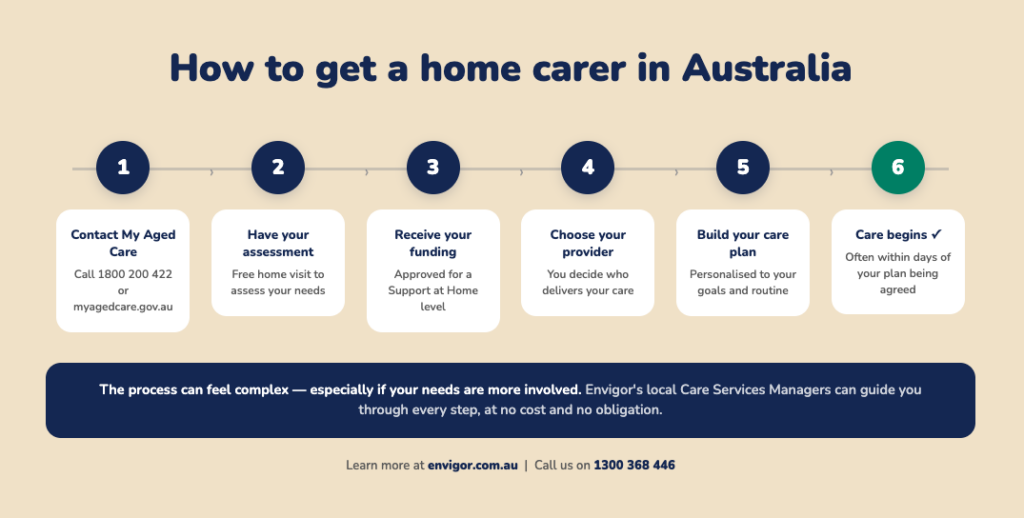
Step 4: Choose your home care provider
This is one of the most important decisions in the process, and it’s entirely yours to make. You are not assigned a provider like with CHSP. You choose who delivers your care, and you can change providers at any time if it’s not the right fit.
When comparing providers, it’s worth asking: Do they operate locally, or are carers travelling long distances? Can they offer consistency – the same carer or small team? How do they handle changes to your schedule? What qualifications do their carers hold? Is there a local person you can actually speak to?
Envigor operates across Queensland with local Care Services Managers in each area – real people who know your community and can meet with you in person.
Step 5: Build your care plan
Once you’ve chosen a provider, they’ll work with you to create a care plan. A care plan is a personalised document that sets out exactly what support you’ll receive, when, and how it fits within your funding budget.
A good care plan is built around your goals and preferences, not a standard checklist. It should reflect how you want to live, not just what tasks need doing. At Envigor, this process starts with a proper conversation.
Your care plan isn’t fixed. It’s reviewed regularly and updated whenever your needs change.
Step 6: Care begins
Once your care plan is agreed, your carer can start within a matter of days. You’ll be introduced to your carer before visits begin, so there are no surprises.
From here, it’s about building a routine and a relationship. Most people find the first few visits can feel a little strange or awkward, and then it quickly becomes a normal and welcome part of the week.
What if I want to arrange care privately?
If you’d prefer not to go through the My Aged Care process, or if you need care quickly while waiting for an assessment, private (self-funded) care is also available. There’s no assessment required, you simply contact Envigor directly and we can arrange support as soon as a care plan is in place.
Private care is charged at an agreed rate and isn’t subsidised by the government, but it’s a straightforward option for those who want to move quickly or supplement existing funded care.
How Envigor can help
The steps above are clear in theory. In practice, the paperwork, the waiting, and the decision-making can feel overwhelming – especially when you’re already managing a lot.
Envigor’s Care Services Managers are based across Queensland and offer free, no-obligation consultations. We can help you understand your funding, answer questions about the process and make sure the care you receive is genuinely right for your situation.
Frequently asked questions
How long does the whole process take?
The honest answer is it depends. From your first call to My Aged Care to care starting, it depends on how urgent your needs are, government funding availability, which program you are approved for, and the amount of packages being released. Some people wait months, others years. If you need care urgently, speak to Envigor directly as private care can begin much sooner.
What if I’m already on a waitlist?
If you’ve been assessed but are waiting for funded care to begin, Envigor can arrange private care in the meantime so you’re not going without support. Once your funded package is activated, we can transition you across seamlessly.
Can I change providers later?
Absolutely. You have the right to change home care providers at any time. Your funding follows you – it belongs to you, not your provider.