What is Support at Home?
Support at Home is the Australian Government’s program for funding in-home aged care. It provides eligible older Australians with funding to access the services they need to live safely and independently in their own homes.
The program is managed through My Aged Care, funded by Services Australia and delivered by registered aged care providers like Envigor.
Who is eligible?
Support at Home is available to:
- People aged 65 and over
- Aboriginal and Torres Strait Islander people aged 50 and over
- People aged 50 and over who are homeless or at risk of homelessness
To access the program, you’ll need to be assessed through My Aged Care. Following assessment, eligible people are approved for a funding level and connected with a registered care provider to develop a personalised support plan.
Getting approved and getting funded
One of the most important things to understand about Support at Home is that being approved doesn’t always mean you’ll receive full funding straight away.
After approval, some people are placed on a waiting list before funding is allocated. During this waiting period, you may receive a Minimum Service Offering (MSO), which provides 60% of your approved funding level to ensure you have access to some support while you wait for full allocation.
Once full funding becomes available, the remaining 40% is released and you move on to your full support budget.
Priority for funding allocation is based on an automatic priority rating – High, Medium, or Standard – determined at the time of your assessment.
Over the next decade, the government plans to make 300,000 additional home care places available across Australia, which may reduce waiting times though demand is extremely high for the program.
What are the Support at Home funding levels?
Support at Home uses eight funding levels, designed to match the level of support to each person’s assessed needs. Higher levels provide more funding for people with more complex care requirements.
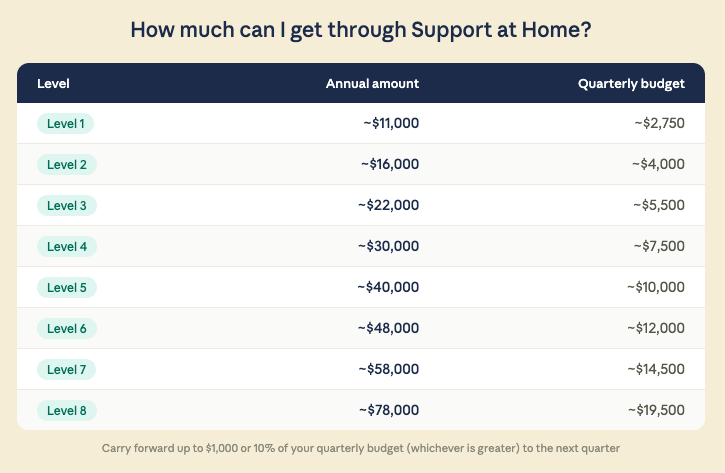
Your annual funding is divided into four equal quarterly budgets. If you don’t use your full allocation in a given quarter, you can carry forward up to $1,000 or 10% of your quarterly budget (whichever is greater) to cover unexpected needs in the following quarter.
Short-term pathways
In addition to ongoing care funding, Support at Home includes three short-term pathways:
Restorative Care Pathway: Short-term support (typically 6–12 weeks) to help you maintain or regain your independence after illness, injury, or a change in your condition.
End-of-Life Pathway: For people in the final three months of life who wish to remain at home. This pathway provides additional support during that time.
Assistive Technology and Home Modifications: Funding to help with equipment and home modifications that support your safety and independence, across three tiers:
- Low: up to $500
- Medium: up to $2,000
- High: up to $15,000 (within a 12-month period)
What services are covered?
Support at Home services fall into three categories:
Clinical supports: Nursing, allied health and other health-related care. These are fully funded by the government and you’ll pay no co-contribution. From October 2026, personal care services such as showering and grooming will also move into this category, meaning they will become fully government-funded with no co-payment required.
Independence supports: Social support and transport. A moderate contribution applies. Note that personal care (such as help with showering) currently sits in this category but will move to Clinical supports from October 2026.
Everyday living supports: Domestic help such as cleaning, gardening and meal preparation. These attract the highest contribution rate.
How do home care co-contributions work?
The amount you contribute depends on both the type of service and your financial situation. Clinical services are always fully government-funded. For independence and everyday living supports, contribution rates are means-tested.
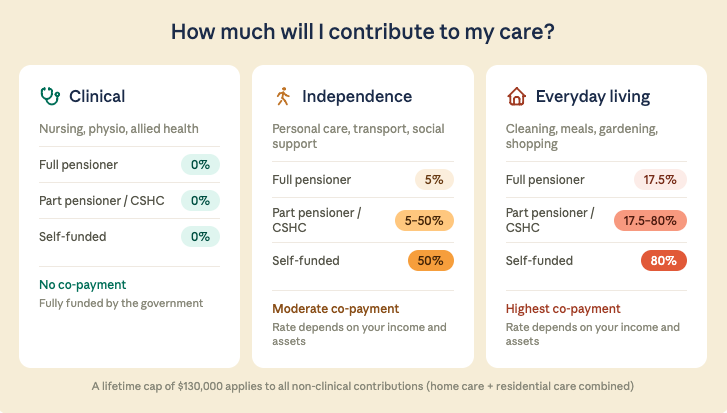
There is a lifetime cap of $130,000 on contributions to non-clinical care. This cap applies across both home care and residential aged care combined.
If you’re struggling to afford your contributions, you may be eligible for financial hardship assistance. If approved, the government can cover some or all of your costs.
What about the Commonwealth Home Support Programme?
The Commonwealth Home Support Programme (CHSP), which funds entry-level services like transport, meals and social activities, is expected to transition into Support at Home at a future date. The government has indicated this will be no earlier than 1 July 2027, though a confirmed timeline hasn’t been set. CHSP services continue to operate as normal in the meantime.
What this means for you
Support at Home is designed to give older Australians more flexibility, a clearer funding structure and a fairer approach to costs, with the goal of helping people stay safely at home for longer.
Navigating the system can still feel complex, especially when it comes to understanding your funding level, contributions and what services you can access.
That’s where Envigor can help. Our team can walk you through your options, help you understand what you’re entitled to, and make sure you’re getting the most from your Support at Home funding.