
The early starts. The late nights. The constant worrying. The appointments, the medications, the moments when you set your own needs aside – again.
You are not alone. In Australia, there are about 2.65 million unpaid carers, and the vast majority are family members doing exactly what you’re doing.
It’ important to understand that taking a break is not giving up. It’s one of the most important things you can do for yourself, and for the person you care for.
That’s exactly what respite care is designed for.
What is respite care?
Respite care is short-term, temporary care provided to your loved one so that you, the primary carer, can take a rest.
It might mean a few hours while you go to an appointment, catch up on sleep, or simply sit quietly for a while. It might mean a full week away while someone you trust steps in. Whatever form it takes, respite care exists to give carers breathing room and to make sure the person being cared for continues to receive quality, compassionate support in the meantime.
Who is respite care for?
Respite care supports two people at once.
For the carer, it provides relief from what can be a physically and emotionally exhausting role. Research consistently shows that carer burnout is a serious health risk, and that carers who take regular breaks are better able to provide quality care over the long term.
For the person receiving care, respite means continuing to receive attentive, professional support from a trained carer. Many people actually enjoy the social interaction and the fresh faces that come with respite visits.
Respite care is particularly valuable for:
- Family members caring for someone with dementia or Alzheimer’s
- Spouses providing full-time care at home
- Adult children managing care alongside their own work and family commitments
- Anyone who hasn’t had a proper break in a while and knows they need one
Types of respite care in Australia
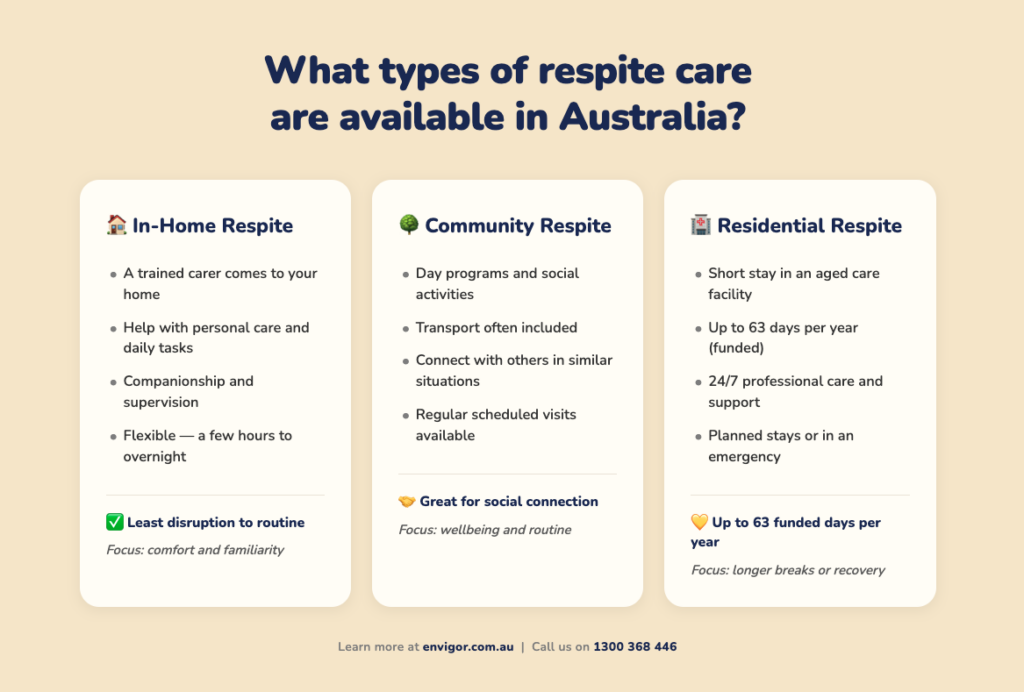
There are several ways to access respite care, depending on your situation.
In-home respite
A qualified carer comes to your home and provides support while you step away. This is the least disruptive option for your loved one. They stay in familiar surroundings, stick to their routine and receive one-on-one attention. This is the model Envigor provides across Queensland.
Community respite
Day programs and community centres offer group activities and social support for a few hours at a time. A great option for people who enjoy getting out and being around others.
Residential respite
A short stay (anywhere from a few days to several weeks) in a residential aged care facility. This option suits situations where more intensive support is needed, or where the carer needs a longer break.
How long does respite care last?
That’s entirely up to you. Respite care can range from a few hours a week to several weeks at a time. In-home respite through providers like Envigor can be scheduled around your routine, whether that’s a regular Tuesday morning booking or a one-off arrangement when you need it most.
The key is flexibility. Your needs as a carer will change over time, and your respite arrangements can change with them.
How is respite care funded in Australia?
The good news is government funding is available for respite care through several pathways.
Support at Home
Australia’s primary home care funding program. Your loved one’s Support at Home package can include funding for in-home respite as part of their Independence support services. If they haven’t been assessed yet, contact My Aged Care on 1800 200 422 to get the process started.
Commonwealth Home Support Programme (CHSP)
For people with lower-level care needs, CHSP funding can cover community respite and some in-home support. Entry-level assessments are available through My Aged Care.
NDIS
For people under 65 with a disability, the NDIS includes funding for respite care (called ‘short-term accommodation and assistance’). Contact your NDIS planner to discuss how to include it in your plan.
Department of Veterans’ Affairs (DVA)
Eligible veterans and war widows/widowers may be able to access respite care through DVA programs. Call DVA on 1800 838 372 to find out more.
How do I arrange respite care?
- Contact My Aged Care (1800 200 422 or myagedcare.gov.au). Register your loved one and explain that you’re looking for respite care support.
- Have an assessment. An aged care assessor will visit at home or using a video call to understand needs and determine eligibility for funding.
- Choose a provider. Once funding is in place, you choose who delivers the care. You’re not locked in, you can always change providers if it’s not the right fit.
- Build a care plan. Your provider will work with you to set up a schedule that works around your life.
If your loved one already has a Support at Home package, speak to your current provider about adding respite to the care plan. Or contact Envigor directly, our local Care Services Managers can guide you through the options available in your area.
What to expect from an Envigor respite carer
Envigor provides in-home respite care across Queensland. All our carers hold a minimum Certificate III in Individual Support, and we do our best to match you with a consistent team so your loved one isn’t meeting a different stranger each time.
Our approach is simple: we care for your loved one the way we’d want our own family cared for. That means turning up on time, following the care plan, and treating the person in our care with dignity and respect.
And if something changes or you need to adjust the arrangement, your local Envigor team is always just a phone call away.
Frequently asked questions
Is respite care means-tested?
It depends on the funding pathway. Support at Home services may involve a co-payment based on income. Your provider can walk you through what to expect. You can also use the fee estimator on the My Aged Care website.
Can I choose who provides the respite care?
Yes. You have the right to choose your provider, and to change providers if you’re not happy. This is your care, and your decision.
What if I need respite care urgently?
If your situation is urgent – for example, you’re unwell and can’t provide care – contact My Aged Care first, then reach out to your local Envigor team. We’ll do our best to arrange support as quickly as possible.
What if my loved one doesn’t want a carer?
This is common. Many people are initially resistant but warm to a regular carer over time. It can help to frame it as “a visitor” or “a helper” rather than a carer, and to keep the first visit short and low-key. Our Care Services Managers can offer advice based on your specific situation.