
Both are government-funded. Both help older Australians get support at home. But they’re not the same thing, and understanding the difference matters because the program you’re on determines what support you can access, how much funding you receive and how flexible your care can be.
What is the Commonwealth Home Support Programme (CHSP)?
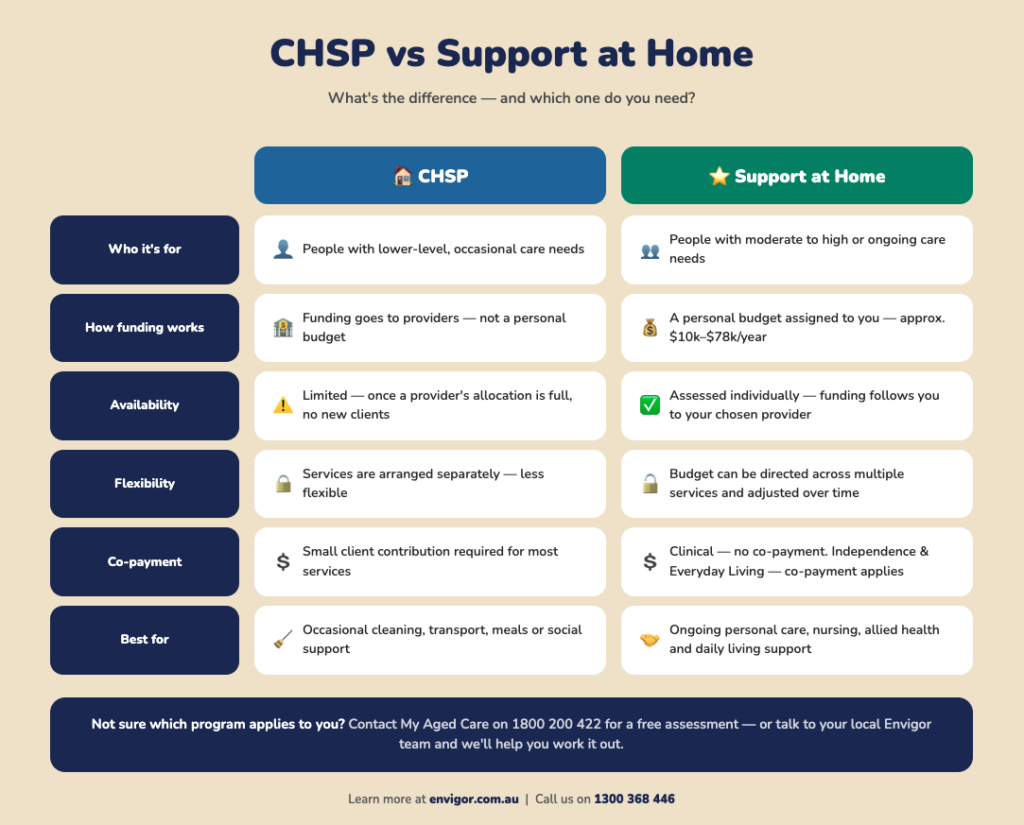
The CHSP is Australia’s entry-level home care program. It’s designed for older people who need a small amount of help to stay independent at home. Think a regular cleaning visit, help with transport to appointments, or a delivered meal a few days a week.
CHSP services are subsidised by the government, meaning you pay a small contribution and the government covers the rest. However, CHSP isn’t a personal budget. You can’t pool funding across different services or roll it over from month to month. Each service is funded and arranged separately.
One thing worth knowing as well is that CHSP funding is allocated directly to providers, not individuals. Each provider receives a set amount of funding for their region and once that allocation is committed to existing clients, they may have little or no capacity to take on new ones. This means availability can vary significantly depending on where you live and which providers operate in your area. And it’s not uncommon to be told there’s a waitlist or no current availability.
CHSP is typically suited to people who:
- Are generally managing well at home but need occasional help with specific tasks
- Have lower-level care needs that don’t require a comprehensive care plan
- Are waiting for a Support at Home assessment or package
What is Support at Home?
Support at Home is Australia’s more comprehensive home care program. It’s designed for people with moderate to high care needs – those who require regular, coordinated support across multiple areas of daily life.
Unlike CHSP, Support at Home works as a personalised funding budget. You’re assigned one of eight funding levels ranging from about $10,000 to $78,000 per year based on your assessed needs. That budget is yours to direct, in partnership with your provider, toward the services that matter most to you.
Support at Home covers three broad categories of services:
- Clinical support: Nursing, allied health, preventative programs – no co-payment
- Independence support: Personal care, transport, social support – co-payment applies
- Everyday Living: Cleaning, meals, mowing, home maintenance – co-payment applies
What’s the key difference?
The simplest way to think about it is that CHSP is for lighter, occasional needs, and Support at Home is for ongoing care across multiple areas of life.
CHSP is more like a set of individual services you can tap into as needed. Support at Home is a full care arrangement – a budget, a care plan, a named provider and a consistent team who knows you.
Another important distinction is flexibility. With Support at Home, some unused funds can roll over, services can be adjusted as your needs change and your care plan is reviewed regularly. With CHSP, each service is more standalone.
Which program am I eligible for?
Eligibility for both programs is determined through an assessment arranged by My Aged Care. For most people, this means contacting My Aged Care (1800 200 422 or myagedcare.gov.au) and requesting an assessment. An aged care assessor will then visit at home to understand your situation.
If your needs are lower-level, you’ll likely be directed toward CHSP. If your needs are more complex or ongoing, you’ll be assessed for Support at Home and assigned an appropriate funding level.
It’s worth noting that you can’t receive both programs simultaneously for the same types of services. Once you’re approved for Support at Home, CHSP services in those areas are generally no longer available to you. Your Support at Home budget is intended to cover those needs instead.
Can I move from CHSP to Support at Home?
Yes. If your needs increase over time – which is common – you can request a reassessment through My Aged Care. If the assessor agrees your needs have grown beyond what CHSP covers, you’ll be transitioned to Support at Home.
It’s a good idea to request a reassessment if you find you’re regularly needing more support than your current services provide, or if your health or circumstances change significantly.
What does Envigor provide?
Envigor only delivers services under the Support at Home program across Queensland. We are not a CHSP provider.
Frequently asked questions
I’ve been told I’m on CHSP but I feel like I need more help. What should I do?
Contact My Aged Care and request a reassessment. Explain that your needs have changed or increased. An assessor will visit again and determine whether Support at Home funding is more appropriate for your situation.
Is Support at Home means-tested?
Clinical services under Support at Home (nursing, allied health) have no co-payment. Independence and Everyday Living services involve a co-contribution that is income-tested. My Aged Care’s fee estimator tool can give you an estimate before you commit to anything.
Can I choose my own provider under both programs?
No. Under CHSP, you are generally given a provider. Under Support at Home, you can choose who delivers your services, and can change providers if the arrangement isn’t working for you.
I’m under 65. Does any of this apply to me?
CHSP and Support at Home are both designed for people aged 65 and over (or 50 and over for Aboriginal and Torres Strait Islander people). If you’re under 65 and have a disability, the NDIS is likely the more relevant program. Contact Envigor or My Aged Care and we can point you in the right direction.